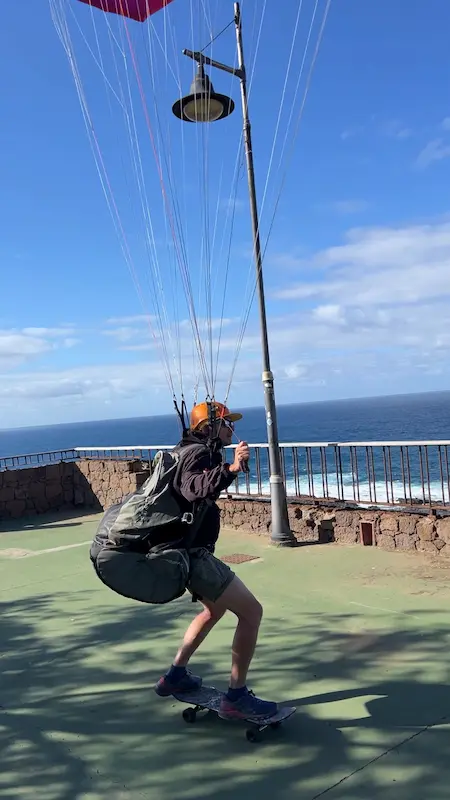
Over the last few days I’ve posted a video on Facebook that’s been getting way more traction than I expected. That’s not a coincidence: what you see there isn’t a one-off “crazy idea”, but the start of something I’ve been thinking about and testing with a clear purpose. I call it Paraskating: a real fusion of flight and wheels, where paragliding lift and the flow of skating meet on common ground.
In this post I explain what Paraskating is, why it can grow into a real discipline (and not just a viral clip), and the technical foundations you need to understand it properly from day one.
This video is a first glimpse of what I mean by Paraskating: it’s not about “dragging a wing” or improvising in sketchy wind. It’s about using clean airflow to generate traction and control while moving on wheels. The feeling is very specific—at times it’s closer to surfing than flying—but it still requires real paragliding technique for it to be stable and repeatable.
How the idea started
This didn’t come from a bored afternoon. It came from something simple: I’ve spent years moving between two worlds that share more than most people think. On one side, paragliding—where everything is about reading the air, managing energy, and keeping fine control. On the other, skating—where your body learns to flow, absorb, balance, and work with inertia.
At some point the question was inevitable: what happens if you combine the logic of ground handling (wing control, pressure, direction, apparent wind) with the clean, stable movement of wheels? Not as a “social media invention”, but as a system you can repeat, train, and improve.
That’s how Paraskating started: first as very basic tests, then by refining conditions, and finally by chasing a specific feeling—moving smoothly over the ground while the wing works efficiently, without being overpowered and without relying on tricks. The video going viral was simply the push to say: alright, this deserves a proper explanation.
What Paraskating actually is
Paraskating is a hybrid discipline where you combine a paraglider wing (or a light wing, depending on the set-up) with movement on wheels to generate traction, directional control, and a “gliding” sensation you don’t get from classic flying or skating on their own. The key is that the wing is not an accessory—it’s the aerodynamic engine of the system, which is why real ground handling technique matters so much.
To be clear: it’s not “going downhill with a wing”, and it’s not just kite plus a skateboard. The difference is in the type of wing, how you manage energy, and the objective. Paraskating is about flow and control with moderate power, working with apparent wind and wing stability while your body and the wheels absorb the terrain.
In other words: it’s a mix of real ground handling, precise wind reading, and solid skating technique. If any of those three pillars fail, it stops being Paraskating and turns into improvisation.
Conditions and required skill level
Before talking about “how good it looks”, you have to talk about conditions. Paraskating only makes sense when the wind is clean and predictable, the space is wide, and the terrain lets you roll without surprises. It’s not something you can force anywhere, and it’s not something you try for the first time on a gusty day.
From a piloting standpoint, you need strong wing control on the ground: inflation, corrections, pressure control, and the ability to keep the wing stable without going into survival mode. If you already struggle to keep the wing steady in a ground handling session, adding the “wheels” factor won’t help—it will make it harder.
And from a skating standpoint, it’s not enough to “be able to ride a board”: you need real stability, the ability to brake, read the surface, and react without stiffness. Your body has to stay loose and precise, because any tension turns into abrupt inputs that the wing will amplify.
Basic rule: if you train it, you train it progressively—first with minimal power, then with controlled power, and always with enough margin to release, brake, and abort without drama.
Gear and basic set-up
Here, the set-up matters, because the goal is not to be overpowered—it’s to get stable traction and fine control. In my case I’m using a standard paraglider wing, not a miniwing. What makes the difference is not the size of the wing, but how you manage power, pressure, and apparent wind while you roll.
The environment is just as important: you need clean, predictable wind, plenty of space, and a surface that lets you roll smoothly without fighting every meter. If the spot doesn’t give you room to brake, correct, or abort calmly, it’s not the place to train it.
Gran Canaria has given me a very specific context to explore this. Up north, the wind often comes in laminar and clean, and we also have sections of road that are quiet and in great condition. That creates a rare combination: excellent airflow and surfaces that let you roll smoothly—something that’s not easy to find elsewhere.
And then there’s the real day-to-day side of being a pilot: you don’t always have the “perfect” landing available. Sometimes proper landings are simply not there, or the terrain doesn’t make it easy, and that’s when you have to adapt with a clear head. That scenario—clean wind, limited options, and the need to adjust quickly—was one of the triggers for starting to test this fusion of flight and wheels.
For me, Paraskating comes from that: an island that forces you to read the air, solve problems, and move with creativity—without losing technical control.
From viral clip to a real discipline
It’s great that the video has spread, but the interesting part isn’t the number—it’s that the idea makes sense at first glance. The mix works because there’s a logic behind it. It’s not “paragliding with a skateboard” as a label, but a different way of working the wind when you have a rollable surface and clean air.
Many disciplines started like this: first as an experiment, then as a repeatable technique. The same can happen here. If you want Paraskating to be taken seriously, the difference is treating it like a system: conditions, control, progression, and enough margin to abort.
What’s next
My plan is to keep documenting Paraskating in an organized way, so you can see the progression—not just a single clip.
If you want to follow this project:
- Follow me on social media to see the next sessions and tests. ( YouTube, Facebook, TikTok, Instagram )
- If you fly in Gran Canaria and you’d like to collaborate or film, send me a message and we’ll set it up.
FAQ
What exactly is Paraskating?
A fusion of paragliding and movement on wheels where the wing provides traction and aerodynamic control while you roll—focused on flow and stability, not crazy power.
Why did it start in the north of Gran Canaria?
Because we often get clean, laminar wind and places where you can roll smoothly—and sometimes the “textbook” landings simply aren’t available, so you have to adapt.
Is it a real discipline or just a viral video?
It can become a discipline if it’s treated as a trainable technique: clear conditions, progression, and method. Without that, it stays a clip.
What makes it work?
Real wing control on the ground, power management, and choosing the right spot. The foundation is piloting, not a “trick”.
Are you going to publish more content?
Yes: conditions, technique, common mistakes, and the evolution of the system—so it’s understood as a discipline, not an isolated scene.